
BlogSpeaking
Pronunciation practice you can hear and see
AIEO checks pronunciation from the recording itself, picks the sentences that scored lowest for stress, rhythm and intonation, and draws your voice beside a model voice.
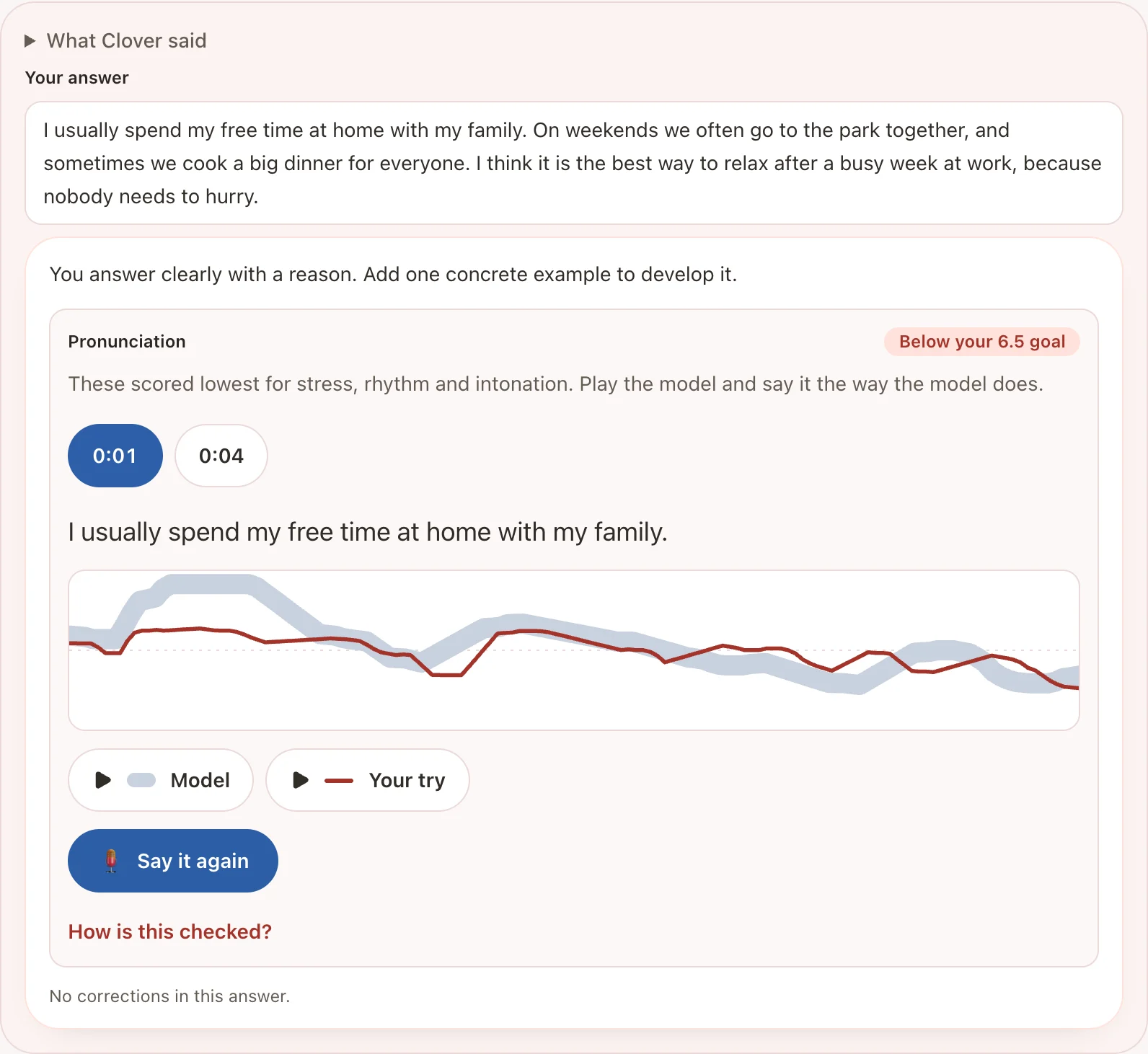 (opens the full-size screen in a new tab)
A transcript shows the words you said, not how you said them. Pronunciation is a quarter of your Speaking band, so AIEO listens to the recording itself: how your voice rises and falls, where you pause and which words you stress.
Checked from the sound, not the words
Pronunciation is checked on Part 1, 2 and 3 answers with at least ten seconds of speech: recorded answers, live practice and the full mock test. A speech assessment model scores how natural your stress, rhythm and intonation sound across each stretch of the answer, and AIEO compares that with IELTS Pronunciation at your goal band. Each plan includes a number of checks.
The answer then shows one of two results: it meets your goal, or it is below it. One answer is too little evidence for a band, so it never gets one. A full mock test gives an estimated Pronunciation band from all three parts.
The sentences that scored lowest
When an answer is below your goal, AIEO places each sentence of your transcript on the recording and scores it on its own. Up to three sentences that scored lowest come back to practise, each named by when you said it, such as 0:42.
For the sentence in front of you, play your own recording of it, then a model voice reading the same words. Hearing the two side by side shows you what to change better than a description of it would.
See your voice as a line
Both voices are drawn as lines showing how the voice rises and falls through the sentence. The model is a wide grey lane; your answer is a coral line through it. A line that stays flat where the model rises and falls, or that breaks in the middle of a phrase, is easy to spot.
- Press Say it and say the sentence again. Your try is drawn over the lane, so you can see whether it moves the way the model does.
- Try as often as you like. Each try is measured in your browser and never sent or saved.
- When it sounds closer, say the whole answer again. That is what checks it against your goal.
Your answer's recording stays in your browser tab and is not saved. Once that tab is closed, the sentences are still there to practise with the model voice.
Why there is no list of wrong words
IELTS examiners name the words they heard as mispronounced in their commentary on the published samples. We tested the speech checkers available to us on those samples. They named almost none of the examiners' words, and they flagged words that strong speakers said well. A list like that would point you at the wrong words, so AIEO shows none.
The score for stress, rhythm and intonation did follow the examiners' bands, so that is what AIEO measures and what picks your sentences.
How close the band comes
In a full mock test, the same measure sets the estimated Pronunciation band. On the 12 examiner-marked speakers IELTS publishes, 9 were given the examiner's own Pronunciation band and none was put above it, each tested as a speaker the scale had never heard. See the accuracy page
A full mock is the closest practice to the real test. How the mock is marked
Start with one answer
Lite lets you try every part of AIEO for 14 days, and a new account gets it free once its email is verified. Write one essay or answer one Speaking question and see what happens after the band.
Screens captured on 15 November 2026 from AIEO test accounts. Names and answers are test data, and bands are practice estimates, not IELTS results.